Red light therapy has become increasingly visible in skincare, wellness and recovery settings. It is often described online as a solution for everything from ageing skin to muscle recovery and sleep. The reality is more measured: photobiomodulation is a legitimate area of scientific study, but results depend on the device, wavelength, dose, treatment area, timing and reason for use.
Understanding what the treatment is—and what it cannot promise—can help you decide whether it may be a useful supportive addition to your plan.
What is red light therapy?
Red light therapy is commonly used to describe photobiomodulation, a non-invasive treatment that exposes tissue to selected wavelengths of red or near-infrared light. These wavelengths are delivered using light-emitting diodes or low-level lasers, depending on the device.
Photobiomodulation does not use ultraviolet light and is not intended to tan or deliberately heat the skin. Researchers are studying how light at specific parameters may influence cellular activity and biological processes. The response is dose-dependent, which means that more light or longer exposure is not automatically better.
Why do treatment parameters matter?
Two devices described as “red light therapy” may not deliver the same treatment. Important differences include:
- the wavelengths emitted;
- the energy and power delivered;
- the distance between the device and the body;
- the size and depth of the treatment area;
- the duration and frequency of exposure; and
- whether the protocol is designed for skin or a recovery-related goal.
This is why results from one research protocol cannot automatically be applied to every mask, panel, bed or handheld device.
Red light therapy and skin support
In aesthetic settings, red and near-infrared light may be considered as a supportive treatment for selected skin-quality goals. Depending on the device and protocol, it may be used as a standalone session or alongside a professionally planned facial programme.
Some devices have been studied for concerns such as the appearance of fine lines, while photobiomodulation is also explored in relation to skin recovery processes. However, it should not be presented as a replacement for daily sun protection, suitable skincare, medical assessment of a skin condition or a procedure specifically indicated for another concern.
When it forms part of an advanced skincare programme, the timing should be selected around the primary treatment and the condition of your skin.
What does the evidence say about recovery?
Research into photobiomodulation and physical recovery has produced varied findings. Some reviews of local treatment report possible benefits for fatigue recovery or selected post-exercise measures. Other reviews find no evidence of improved strength or functional capacity.
Whole-body photobiomodulation is a newer area with limited evidence. A 2025 systematic review identified only five small studies and found no demonstrated benefit for exercise performance or recovery markers. This does not prove that every protocol is ineffective, but it does mean that broad promises about faster recovery or improved performance are not justified.
At MC Aesthetics, red light therapy should be considered supportive wellness or recovery care, not treatment for an undiagnosed injury, persistent pain or medical condition.
What might a session feel like?
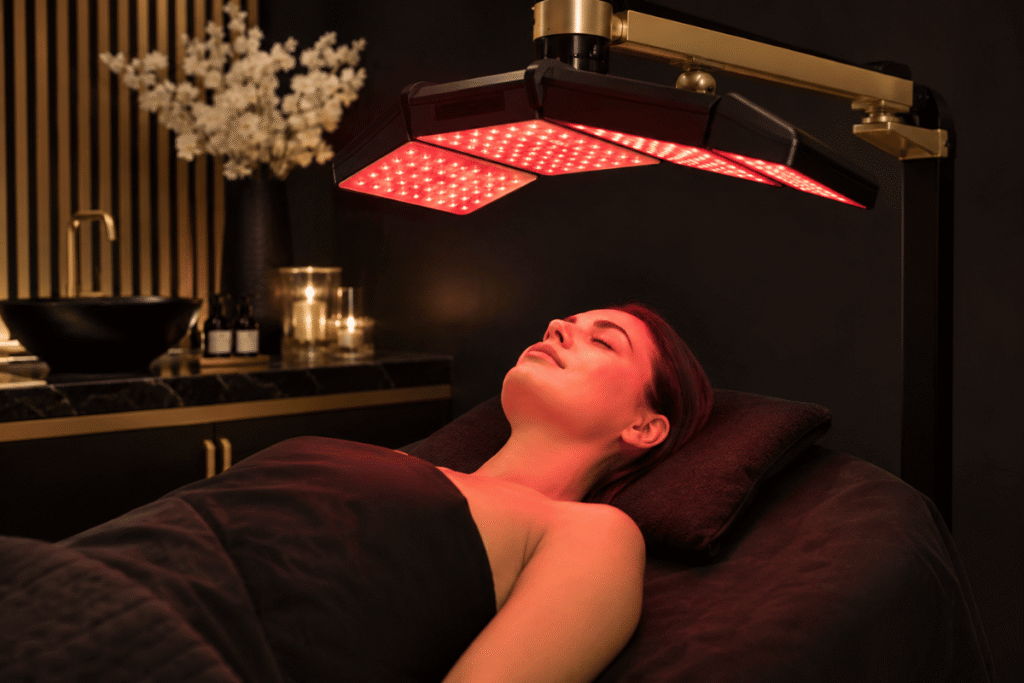
A session is non-invasive. You are positioned at the distance specified for the device while the treatment area is exposed to light for a set period. You may experience gentle warmth from the environment or equipment, but the treatment should not feel painfully hot.
There is generally no planned downtime from red light exposure alone, although aftercare may be required when it is combined with another facial or body treatment. Follow the guidance for the primary procedure in that situation.
Who needs additional caution?
Tell the therapist about your medical history, medication and the reason you are considering treatment. Additional assessment or medical clearance may be appropriate if you:
- take medication or use products that increase light sensitivity;
- have a light-sensitive skin or medical condition;
- have an active rash, infection, unexplained lesion or recent burn;
- have a relevant eye condition;
- are pregnant or breastfeeding;
- are undergoing cancer treatment or have been advised to avoid light therapy; or
- hope to use the treatment for persistent pain, an injury or another medical concern.
Appropriate eye protection and the device manufacturer’s instructions should be followed. Do not stare directly into a bright light source unless the device and protocol specifically permit this.
Red light therapy is not the same as every other light treatment
Photobiomodulation should not be confused with ultraviolet tanning, intense pulsed light, laser resurfacing or photodynamic therapy. These technologies use different energy, mechanisms and clinical protocols. They also have different indications, risks and preparation requirements.
If you are unsure which treatment has been recommended, ask for the device name, the type of light being used and the intended purpose of the session.
How many sessions are needed?
There is no reliable universal number. A protocol may involve a single supportive session or a planned course, depending on the device and goal. Your response should be reviewed rather than assuming that indefinite treatment is necessary.
Be cautious of packages promising permanent transformation or guaranteed results. Individual outcomes vary, and the evidence for one purpose does not establish effectiveness for another.
A considered option at MC Aesthetics
Red Light Therapy at MC Aesthetics may be explored for selected skin, wellness or recovery-support goals following an individual suitability check. The team will explain the proposed protocol, practical expectations and any precautions relevant to you.
Review the pre- and post-care guidance before your appointment, and follow any personalised instructions provided. If you are unsure whether red light therapy belongs in your plan, request a consultation at MC Aesthetics in George.
This article provides general educational information. Red light therapy is not a substitute for diagnosis or treatment by a qualified healthcare practitioner. Evidence varies by device, protocol and intended use, and results cannot be guaranteed.